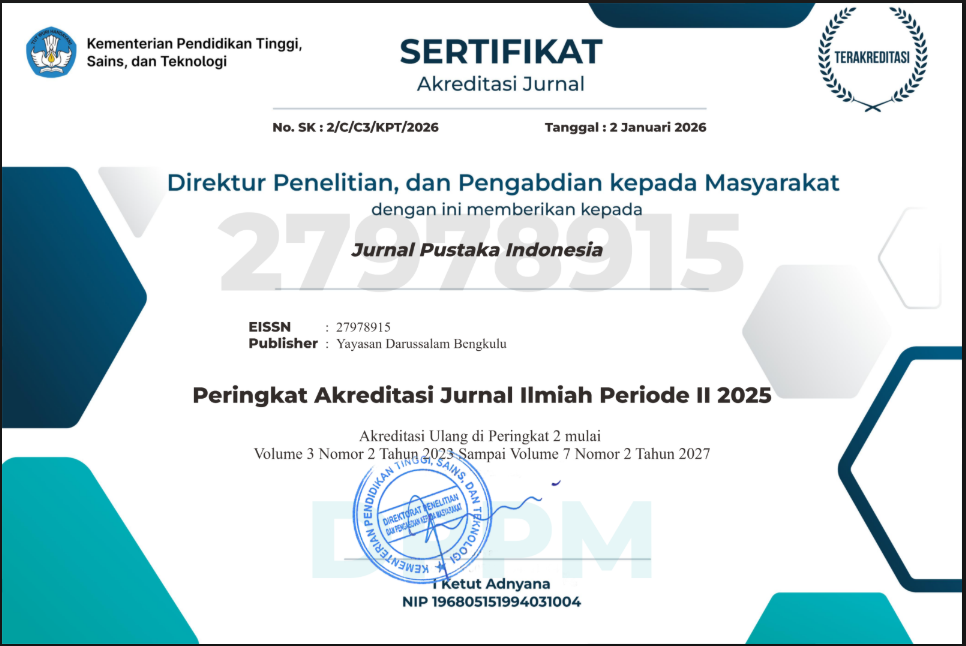
| ACCREDITATION |
1.png) |
|
|
Aim and Scope
JPI (Jurnal Pustaka Indonesia) is a peer-reviewed journal that publishes original research articles, review articles, and critical scholarship in the fields of language studies, education, educational management, and library and information science. The journal provides an academic platform for scholarly works that address language, learning, education, literacy, institutional development, and information practices in diverse educational and social contexts.
The journal welcomes manuscripts addressing any language, including Indonesian, English, Arabic, local and indigenous languages, and other world languages, and encourages comparative, interdisciplinary, and context-sensitive perspectives. In addition to language-focused scholarship, the journal also welcomes studies on learning innovation, educational development, management practices in educational institutions, and the role of libraries in supporting learning, literacy, and knowledge dissemination.
The scope of the journal includes, but is not limited to, the following areas:
1. Language Education
Including the teaching and learning of Indonesian, English, Arabic, local languages, and other foreign languages; language teaching strategies; language assessment; language curriculum development; literacy and multiliteracies; and innovations in language teaching and learning.
2. Language and Linguistics
Including applied linguistics, sociolinguistics, psycholinguistics, pragmatics, discourse analysis, semantics, phonology, morphology, syntax, bilingualism, translation studies, communication studies, intercultural communication, digital communication, media discourse, and language studies in social, cultural, educational, and communicative contexts.
3. Learning Methods, Media, and Technology
Including teaching methods and instructional strategies; learning media development; digital learning resources; multimedia-based instruction; interactive learning tools; educational technology; online, blended, and hybrid learning; technology-enhanced learning; artificial intelligence in education; digital assessment; learning management systems; virtual, augmented, and immersive learning environments; and innovations in teaching and learning practices across educational settings.
4. Education Studies
Including curriculum studies, educational evaluation, teacher professional development, student learning development, inclusive education, character education, educational innovation, and literacy development in educational contexts. It also includes studies in economic education, entrepreneurship education, legal education, civic education, religious education, social education, environmental education, cultural education, physical education and sport pedagogy, as well as educational welfare and contemporary issues in formal, non-formal, and informal education.
5. Educational Management
Including educational leadership, educational policy, supervision, educational program planning and evaluation, quality assurance, curriculum management, human resource management in education, school organizational culture, governance innovation in educational institutions, digital transformation in educational management, technology-based school administration, educational data management, digital leadership, management information systems in education, and innovation in educational governance.
6. Library and Information Management
Including the management of school, academic, and public libraries; information services; information literacy; collection management; digital transformation in libraries; library automation; user behavior; and the role of libraries in supporting learning, research, and literacy culture.
The journal welcomes empirical research articles, literature reviews, conceptual papers, and innovation-based studies relevant to these fields.







_(3).png)