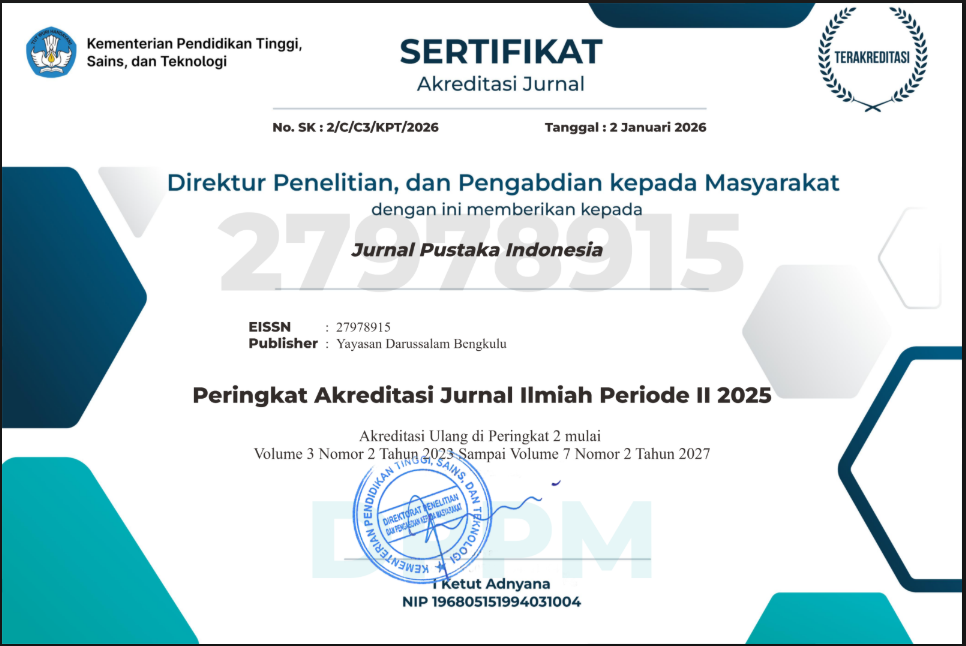
| ACCREDITATION |
1.png) |
|
|
Archives
-
 In Press
Vol. 6 No. 3 (2026)
In Press
Vol. 6 No. 3 (2026)Vol. 6 No. 3 (2026): In Press of JPI: Jurnal Pustaka Indonesia. This issue publishes scholarly works within the journal’s focus and scope, including language education, language and linguistics, learning methods, instructional media and technology, educational studies, educational management, and library and information management. It welcomes original research articles, literature reviews, conceptual studies, and innovation-based research that contribute to the advancement of language, literacy, education, digital learning, institutional development, and contemporary information practices. Articles accepted for this issue are published online progressively after completing the peer-review, revision, copyediting, and production processes. The final issue will be completed and officially published in August-December 2026.
-
 May-August
Vol. 6 No. 2 (2026)
May-August
Vol. 6 No. 2 (2026)Vol. 6 No. 2 (2026): July-August of JPI: Jurnal Pustaka Indonesia. The journal’s focus and scope, including language education, language and linguistics, learning methods, media and technology, education studies, educational management, and library and information management. The issue welcomes empirical studies, literature studies, conceptual papers, and innovation-based research that contribute to language, literacy, education, institutional development, digital learning, information practices, and contemporary academic discourse. Authors are invited to submit high-quality manuscripts that offer clear scholarly contributions and align with current educational and social contexts. Submit your article now and be part of JPI Vol. 6 No. 3 August 2026 – In Press.
-
 January-April
Vol. 6 No. 1 (2026)
January-April
Vol. 6 No. 1 (2026)Vol. 6 No. 1 (2026): January-April of JPI: Jurnal Pustaka Indonesia presents 28 articles authored by 107 contributors from 36 institutional affiliations across three countries: Indonesia, Malaysia, and Tanzania. This issue reflects the journal’s broad academic coverage in language, literature, education, literacy, Islamic studies, digital learning, and educational management. The published articles also discuss contemporary themes such as artificial intelligence, cultural preservation, vocational education, social studies learning, ecological awareness, and institutional innovation. Through these contributions, the issue highlights the dynamic relationship between language, culture, technology, pedagogy, and social development. The diversity of topics and contributors demonstrates the journal’s commitment to supporting interdisciplinary scholarship and strengthening academic dialogue in Indonesian and international educational contexts.
-
 December
Vol. 5 No. 3 (2025)
December
Vol. 5 No. 3 (2025)Vol. 5 No. 3 (December 2025) of JPI: Jurnal Pustaka Indonesia presents four articles written by 19 authors from 4 institutional affiliations. This issue highlights the journal’s commitment to publishing scholarly works in language education, Arabic language learning, educational technology, Islamic education, religious moderation, literacy development, and value-based pedagogy. The articles discuss interconnected themes, including English pronunciation learning through the ELSA Speak application, Arabic Problem-Based Learning for strengthening religious moderation, the epistemological foundation of religious moderation through Unity of Science values, and eco-theology-based Arabic posters for improving reading literacy in Mahārat al-Qirā’ah. Collectively, these contributions show how language, technology, learning media, Islamic values, literacy practices, and classroom innovation can support language competence, ethical awareness, moderation values, and transformative education in contemporary academic contexts.
-
 August
Vol. 5 No. 2 (2025)
August
Vol. 5 No. 2 (2025)Vol. 5 No. 2 (August 2025) of JPI: Jurnal Pustaka Indonesia presents four articles written by 12 authors from five institutional affiliations. This issue highlights JPI’s commitment to Arabic language education, learning media, Islamic pedagogy, literacy development, motivation studies, translation studies, and culturally responsive educational innovation. The articles discuss comic-based Arabic learning media, daʿwah values in Society 5.0 pedagogy, integrative motivation and global career perspectives in Arabic literacy achievement, and Indonesian cultural identity in the Arabic subtitles of Habibi & Ainun. Collectively, these contributions show how language, media, Islamic values, motivation, translation, and culture support literacy, pedagogy, and intercultural communication.
-
 April
Vol. 5 No. 1 (2025)
April
Vol. 5 No. 1 (2025)Vol. 5 No. 1 (April 2025) of JPI: Jurnal Pustaka Indonesia presents four articles written by six authors from four institutional affiliations. This issue highlights JPI’s commitment to language, literature, sociolinguistics, cultural studies, Islamic discourse, and literary psychology. The articles address interconnected themes, including religious politicization in Najib Kilani’s Zhillul Aswad, social and moral dimensions in Aguk Irawan M.N.’s Senandung Bisu, Indonesian and local language use in public and Islamic boarding schools, and personality transformation in Tenderlova’s Meant 2 Be. Collectively, these contributions show how literature, language, religion, identity, and culture support critical literacy and educational reflection.
-
 December
Vol. 4 No. 3 (2024)
December
Vol. 4 No. 3 (2024)Vol. 4 No. 3 (December 2024) of JPI: Jurnal Pustaka Indonesia presents eight articles written by 14 authors from five institutional affiliations. This issue highlights JPI’s commitment to language studies, literature, sociolinguistics, pragmatics, language education, literacy development, and technology-enhanced learning. The articles address interconnected themes, including figurative language in Indonesian contemporary novels, Serawai dialectology, early childhood language development, speech acts in the 2024 Indonesian presidential debate, Wordwall-based formal letter writing, classical Arabic poetry interpretation, acrostic techniques for poetry writing, and regional language use in higher education. Collectively, these contributions show how language, literature, local culture, digital media, and pedagogy support literacy, cultural identity, communicative competence, and educational innovation.
-
 August
Vol. 4 No. 2 (2024)
August
Vol. 4 No. 2 (2024)Vol. 4 No. 2 (August 2024) of JPI: Jurnal Pustaka Indonesia presents eight articles written by 20 authors. This issue highlights JPI’s commitment to language, literature, folklore, sociolinguistics, language education, cultural studies, and classroom-based learning innovation. The articles address interconnected themes, including Bengkulu folklore structures, feminism and gender stereotypes in contemporary novels, Bengkulu cultural portraits in descriptive writing, spoken language use in formal and non-formal communication, STAD-based Indonesian language learning, Sekujang oral tradition, figurative language in student poetry, and cultural values in Bengkulu folk tales. Collectively, these contributions show how language, literature, local culture, and pedagogy support literacy development, cultural preservation, and educational reflection.
-
 April
Vol. 4 No. 1 (2024)
April
Vol. 4 No. 1 (2024)Vol. 4 No. 1 (April 2024) of JPI: Jurnal Pustaka Indonesia presents eight articles written by 23 authors. Published on 18 May 2024, this issue highlights JPI’s commitment to Indonesian language education, literacy, literature, cultural studies, local history, dialectology, and classroom-based learning innovation. The articles address interconnected themes, including Independent Curriculum implementation, Kampus Mengajar literacy support, Bengkulu historical memory, personality analysis in popular prose, Islamic values in poetry, Serawai dialect relatedness, outdoor learning for pantun writing, and grammatical patterns in Indonesian pop lyrics. Collectively, these contributions strengthen the study of language, literature, culture, literacy, and education in Indonesian contexts.
-
 December
Vol. 3 No. 3 (2023)
December
Vol. 3 No. 3 (2023)Vol. 3 No. 3 (December 2023) of JPI: Jurnal Pustaka Indonesia presents eight articles written by 19 authors. Published on 4 December 2023, this issue highlights JPI’s commitment to language education, literature, sociolinguistics, literacy development, local culture, and classroom-based learning innovation. The articles address interconnected themes, including drama listening competence, fantasy text module development, Pekal song analysis, code-switching and code-mixing in Instagram posts, peer tutoring for descriptive text learning, children’s language acquisition, folklore-based teaching materials, and personal letter writing skills. Collectively, these contributions strengthen the study of language, literature, culture, literacy, and Indonesian language pedagogy.
-
 August
Vol. 3 No. 2 (2023)
August
Vol. 3 No. 2 (2023)Vol. 3 No. 2 (August 2023) of JPI: Jurnal Pustaka Indonesia presents eight articles published on 2 August 2023. This issue highlights JPI’s commitment to language education, literature, sociolinguistics, local culture, and classroom-based learning innovation. The articles address interconnected themes, including drama listening competence, fantasy text teaching materials, Pekal song analysis, code-switching and code-mixing in Instagram posts, peer tutoring in descriptive text learning, language use in market interaction, code-switching in religious lectures on YouTube, and explicit instruction for personal letter writing. Collectively, these contributions strengthen studies on Indonesian language learning, literacy, literature, culture, and social communication.
-
 April
Vol. 3 No. 1 (2023)
April
Vol. 3 No. 1 (2023)Vol. 3 No. 1 (2023): April of JPI: Jurnal Pustaka Indonesia presents eight articles written by 25 authors from 2 institutional affiliations. This issue reflects the journal’s commitment to publishing scholarly works in language education, literacy studies, literature, learning methods, instructional media, and culturally grounded academic discourse. The articles in this issue cover diverse but interconnected themes, including the relationship between vocabulary mastery and short-story writing ability, the use of PowerPoint-based pedagogy to improve student achievement, ethical dimensions in Indonesian drama scripts, Arabic song media for listening and vocabulary development, the Pair Check method for procedural text writing, wedding pantun as an ethnopoetic and cultural expression, cooperative learning in Indonesian language instruction, and outdoor study methods for strengthening explanatory text writing. Collectively, these contributions align with the journal’s aim and scope by demonstrating how language, literature, learning media, cooperative pedagogy, oral tradition, and classroom-based innovation function as important spaces for literacy development, cultural preservation, pedagogical improvement, and educational transformation in Indonesian academic and school contexts. The issue also strengthens JPI’s scholarly orientation by bringing together empirical classroom studies, literary analysis, and cultural-linguistic inquiry within the broader fields of language studies, education, educational innovation, and literacy practices.







_(3).png)