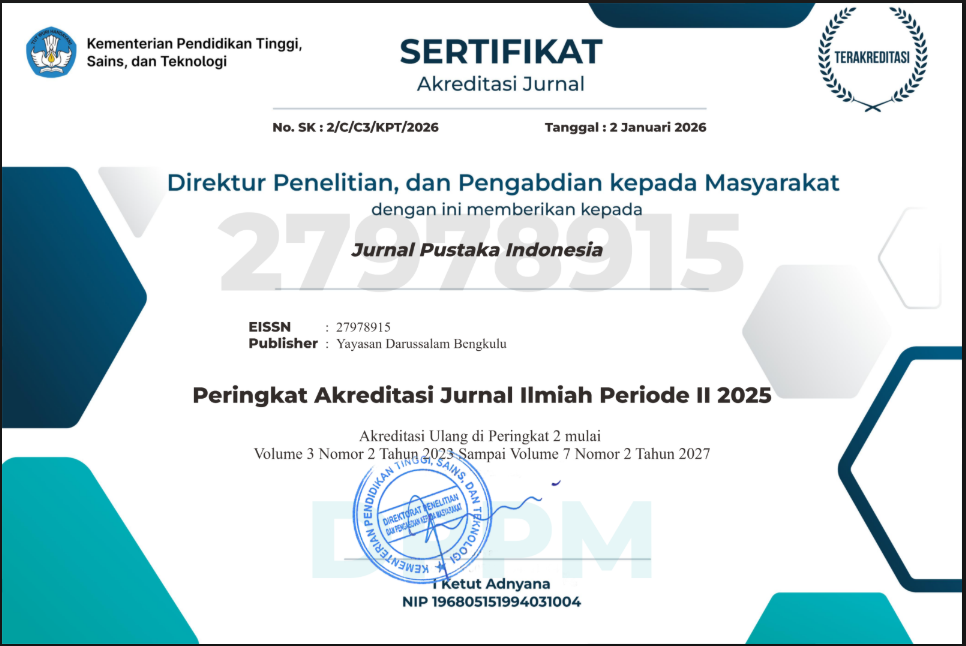
| ACCREDITATION |
1.png) |
|
|
Author Guidelines
JPI (Jurnal Pustaka Indonesia) is a peer-reviewed scholarly journal that publishes original research articles, review articles, and conceptual papers in the fields of language studies, education, educational management, and library and information science. Manuscripts submitted to JPI must be original, have not been published elsewhere, and are not under consideration by another journal.
Authors are required to prepare their manuscripts using the official JPI template. Manuscripts that do not conform to the journal’s formatting and referencing requirements may be returned to the authors before peer review. All submissions must be written in English and should demonstrate clarity, academic rigor, and relevance to the journal’s aim and scope.
1. Manuscript Preparation
The manuscript should be prepared in MS Word format using the official JPI template. Authors are strongly encouraged to ensure that the manuscript has been carefully proofread before submission. Papers must contain at least 2500 words, including the references. Manuscripts should be written in clear academic English and follow the structure required by the journal. The current template indicates a standard research article layout consisting of title, abstract, keywords, introduction, method, results and discussion, conclusion, and references.
2. Manuscript Structure
Title
The title should be concise, specific, and informative, reflecting the main content of the paper. It should preferably contain no more than 18 words and be formatted in bold, 18 pt as indicated in the template.
Author(s)
The names of all authors should be written clearly below the title, followed by their institutional affiliations and email addresses. One author must be identified as the corresponding author and marked with an asterisk (*). The corresponding author’s full affiliation and email address must be provided.
Abstract
The abstract should be written in one paragraph, clearly and concisely summarizing the background of the study, the objective, the method, the principal results, and the conclusion. The abstract must not exceed 250 words.
Keywords
Authors should provide three to sixkeywords that represent the core topics of the manuscript. Keywords should be arranged carefully to improve discoverability and separated by semicolons.
Introduction
The introduction should explain the background of the study, the issue or gap being addressed, relevant previous studies, the significance of the topic, and the objective of the paper. The introduction should clearly position the manuscript within current scholarly discussions.
Method
For original research articles, the method section is mandatory. It should describe the research design, participants or data sources, instruments, procedures, and data analysis techniques clearly enough to enable replication or scholarly evaluation. For review articles or conceptual papers, this section may be adapted according to the nature of the manuscript.
Results and Discussion
This section should present the findings clearly and systematically, followed by an analytical discussion of their meaning and significance. Authors are encouraged to integrate interpretation with the presentation of results rather than merely describing the data. The template also shows that results may be supported by tables and figures formatted according to APA conventions.
Conclusion
The conclusion should directly answer the objective of the study and highlight the contribution of the paper. It should not simply repeat the abstract or restate the results. Where relevant, authors may include implications, limitations, and recommendations for future research or practice.
References
All sources cited in the manuscript must appear in the reference list, and all entries in the reference list must be cited in the text. References should be arranged alphabetically.
JPI uses APA 7th Edition as its referencing style. Authors must therefore use in-text citations in APA style and prepare the reference list accordingly. The 2026 template explicitly labels the reference section as “References (Style APA 7th Edition)”, which means the earlier Chicago-based guideline should no longer be followed. Authors are strongly encouraged to use reference management software such as Mendeley, Zotero, or EndNote to ensure consistency and accuracy.
3. Tables and Figures
Tables and figures should be relevant, clearly presented, and referred to in the main text. They must be numbered consecutively in the order in which they appear in the manuscript. Titles of tables and captions of figures should be concise and informative. As reflected in the template, tables and figures should follow APA-style presentation conventions.
4. Language and Style
Manuscripts must be written in clear and grammatically correct English. Authors should use formal academic language and maintain consistency in spelling, terminology, and style throughout the manuscript. Submissions with serious language problems may be returned for revision before review.
5. Article Types Accepted
JPI welcomes the following types of manuscripts:
- original research articles
- review articles
- conceptual papers
All manuscripts must fit the journal’s focus and scope and make a meaningful scholarly contribution.
6. Editorial Elements
Some elements shown in the published template, such as article history (received, revised, accepted dates) and the publisher’s note on the CC BY 4.0 license, are editorial and publication elements prepared by the journal. Authors mainly need to ensure that their manuscripts contain complete author information, including the corresponding author’s details.
7. Submission Checklist
Before submitting, authors should ensure that:
- the manuscript is written in English;
- the manuscript follows the official JPI template;
- the title, abstract, keywords, and author information are complete;
- the manuscript structure is consistent with JPI requirements;
- citations and references follow APA 7th Edition;
- all references cited in the text are listed in the reference section;
- the manuscript has been proofread carefully;
- the submission is original and is not under review elsewhere.







_(3).png)